You are given two arrays of positive integers, boxes and warehouse, representing the heights of some boxes of unit width and the heights of n rooms in a warehouse respectively. The warehouse's rooms are labelled from 0 to n - 1 from left to right where warehouse[i] (0-indexed) is the height of the ith room.
Boxes are put into the warehouse by the following rules:
- Boxes cannot be stacked.
- You can rearrange the insertion order of the boxes.
- Boxes can only be pushed into the warehouse from left to right only.
- If the height of some room in the warehouse is less than the height of a box, then that box and all other boxes behind it will be stopped before that room.
Return the maximum number of boxes you can put into the warehouse.
Example 1:
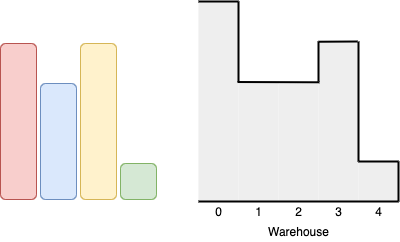
Input: boxes = [4,3,4,1], warehouse = [5,3,3,4,1]
Output: 3
Explanation:
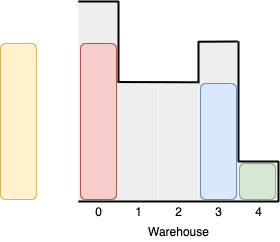 We can first put the box of height 1 in room 4. Then we can put the box of height 3 in either of the 3 rooms 1, 2, or 3. Lastly, we can put one box of height 4 in room 0.
There is no way we can fit all 4 boxes in the warehouse.
We can first put the box of height 1 in room 4. Then we can put the box of height 3 in either of the 3 rooms 1, 2, or 3. Lastly, we can put one box of height 4 in room 0.
There is no way we can fit all 4 boxes in the warehouse.
Example 2:

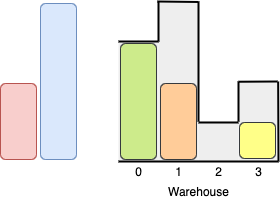
Input: boxes = [1,2,2,3,4], warehouse = [3,4,1,2]
Output: 3
Explanation:
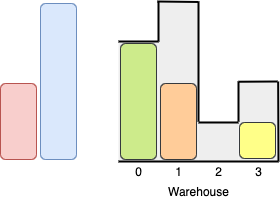 Notice that it's not possible to put the box of height 4 into the warehouse since it cannot pass the first room of height 3.
Also, for the last two rooms, 2 and 3, only boxes of height 1 can fit.
We can fit 3 boxes maximum as shown above. The yellow box can also be put in room 2 instead.
Swapping the orange and green boxes is also valid, or swapping one of them with the red box.
Notice that it's not possible to put the box of height 4 into the warehouse since it cannot pass the first room of height 3.
Also, for the last two rooms, 2 and 3, only boxes of height 1 can fit.
We can fit 3 boxes maximum as shown above. The yellow box can also be put in room 2 instead.
Swapping the orange and green boxes is also valid, or swapping one of them with the red box.
Example 3:
Input: boxes = [1,2,3], warehouse = [1,2,3,4]
Output: 1
Explanation: Since the first room in the warehouse is of height 1, we can only put boxes of height 1.
Example 4:
Input: boxes = [4,5,6], warehouse = [3,3,3,3,3]
Output: 0
Constraints:
n == warehouse.length1 <= boxes.length, warehouse.length <= 10^51 <= boxes[i], warehouse[i] <= 10^9
Companies:
Google
Related Topics:
Greedy
Similar Questions:
// OJ: https://leetcode.com/problems/put-boxes-into-the-warehouse-i/
// Author: github.com/lzl124631x
// Time: O(W + BlogB + WlogB)
// Space: O(W)
class Solution {
public:
    int maxBoxesInWarehouse(vector<int>& B, vector<int>& W) {
        vector<int> s(1, W.size());
        for (int i = W.size() - 1; i >= 0; --i) {
            while (s.size() > 1 && W[s.back()] >= W[i]) s.pop_back();
            s.push_back(i);
        }
        sort(begin(B), end(B));
        int ans = 0;
        for (int i = 1; i < s.size(); ++i) {
            int h = W[s[i]], cnt = s[i - 1] - s[i];
            int num = upper_bound(begin(B), end(B), h) - begin(B) - ans;
            ans += min(cnt, num);
        }
        return ans;
    }
};// OJ: https://leetcode.com/problems/put-boxes-into-the-warehouse-i/
// Author: github.com/lzl124631x
// Time: O(BlogB + W)
// Space: O(1)
// Ref: https://leetcode.com/problems/put-boxes-into-the-warehouse-i/discuss/821966/C%2B%2B-Two-Approaches
class Solution {
public:
int maxBoxesInWarehouse(vector<int>& B, vector<int>& W) {
sort(begin(B), end(B));
for (int i = 1; i < W.size(); ++i) {
W[i] = min(W[i], W[i - 1]);
}
int ans = 0;
for (int i = W.size() - 1; i >= 0; --i) {
ans += ans < B.size() && B[ans] <= W[i];
}
return ans;
}
};// OJ: https://leetcode.com/problems/put-boxes-into-the-warehouse-i/
// Author: github.com/lzl124631x
// Time: O(BlogB)
// Space: O(1)
// Ref: https://leetcode.com/problems/put-boxes-into-the-warehouse-i/discuss/821966/C%2B%2B-Two-Approaches
class Solution {
public:
int maxBoxesInWarehouse(vector<int>& B, vector<int>& W) {
sort(begin(B), end(B), greater());
int ans = 0;
for (int b : B) {
ans += ans < W.size() && b <= W[ans];
}
return ans;
}
};