You have n binary tree nodes numbered from 0 to n - 1 where node i has two children leftChild[i] and rightChild[i], return true if and only if all the given nodes form exactly one valid binary tree.
If node i has no left child then leftChild[i] will equal -1, similarly for the right child.
Note that the nodes have no values and that we only use the node numbers in this problem.
Example 1:
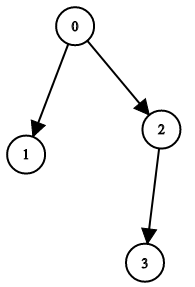
Input: n = 4, leftChild = [1,-1,3,-1], rightChild = [2,-1,-1,-1]
Output: true
Example 2:
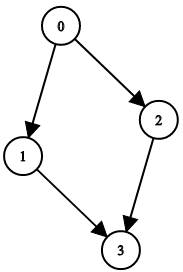
Input: n = 4, leftChild = [1,-1,3,-1], rightChild = [2,3,-1,-1]
Output: false
Example 3:
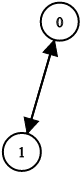
Input: n = 2, leftChild = [1,0], rightChild = [-1,-1]
Output: false
Example 4:
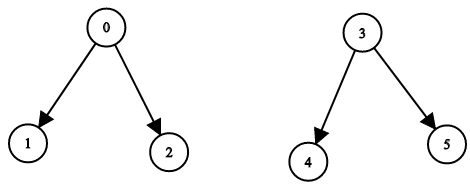
Input: n = 6, leftChild = [1,-1,-1,4,-1,-1], rightChild = [2,-1,-1,5,-1,-1]
Output: false
Constraints:
1 <= n <= 10^4leftChild.length == rightChild.length == n-1 <= leftChild[i], rightChild[i] <= n - 1
Related Topics:
Graph
Firstly, we can check the in-dgree.
- Only one node (the root) has 0 in-degree. All other nodes have 1 in-dgree.
But this is not enough. For example:
[0,-1]
[-1,-1]
This graphy has one circle and one dangling node and satisfies the above requirement.
To rule this scenario out, we can add this requirement.
- If there are more than one node, the node with 0 in-degree must have out-degree.
// OJ: https://leetcode.com/problems/validate-binary-tree-nodes/
// Author: github.com/lzl124631x
// Time: O(N)
// Space: O(N)
class Solution {
public:
    bool validateBinaryTreeNodes(int n, vector<int>& leftChild, vector<int>& rightChild) {
        vector<int> indegree(n);
        for (int i = 0; i < n; ++i) {
            int L = leftChild[i], R = rightChild[i];
            if (L != -1 && indegree[L]++) return false; // if the indegree is more than 1, return false
            if (R != -1 && indegree[R]++) return false;
        }
        int root = -1;
        for (int i = 0; i < n; ++i) {
            if (indegree[i]) continue;
            if (root != -1) return false; // if more than one node with 0 indegree, return false
            root = i;
        }
        return root != -1 && (n == 1 || leftChild[root] != -1 || rightChild[root] != -1); // root must exist, and the root must have out-degree unless there is only one node
    }
};